
Beyond Passive HVAC Filters: The Rise of Active In-Duct Pathogen Neutralization and Continuous Surface Disinfection
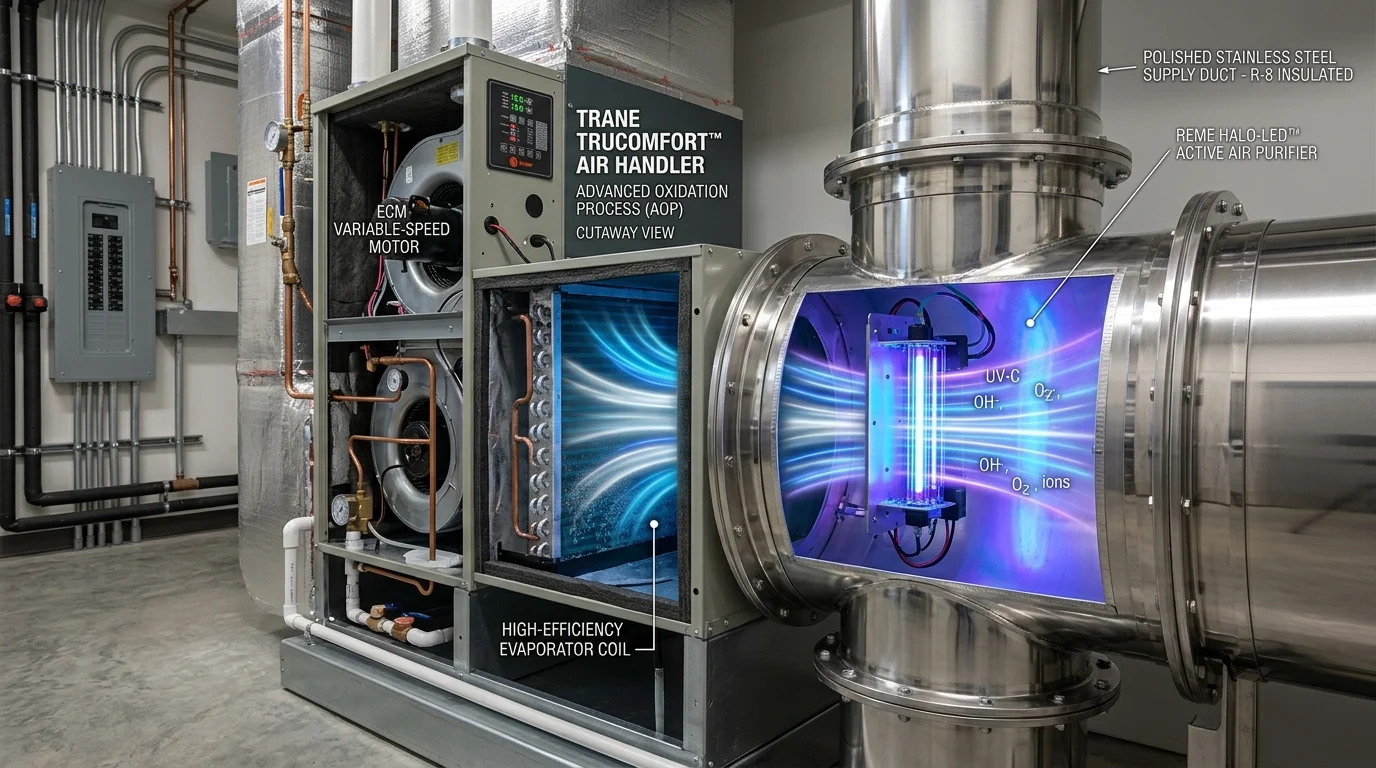
Ask any mechanical engineer or building biologist about standard residential HVAC, and they will share an unsettling reality: conventional air filters are purely defensive and stationary. They only capture particles that are mechanically sucked through the return air grilles. If a mold colony germinates behind baseboards or an airborne virus is expelled in a bedroom, passive filters cannot protect occupants in real time.
The Active Purification Paradigm: Going on the Offensive
Active air purification turns the entire air volume of a residence into a continuous sanitization field. Rather than waiting for contaminants to travel back into the air handler, active technologies generate friendly atmospheric oxidizers—predominantly short-lived hydroxyl radicals and balanced bi-polar ions—that are distributed through the supply ducts into every square foot of the living space.
How SaniActive™ Deactivates Pathogens on Surfaces
State-of-the-art in-duct systems, such as SaniActive™, utilize broad-spectrum titanium dioxide catalytic grids illuminated by targeted UV photons. As moisture in the air passes through the catalytic cell, it produces naturally occurring micro-concentrations of hydrogen peroxide gas and hydroxyl ions (below 0.02 ppm, far below OSHA thresholds). These active molecules drift seamlessly through the ductwork into the room, actively attaching to airborne and surface-bound mold spores, bacteria, and volatile organic compound molecules, deconstructing their lipid membranes and rendering them biologically inert.
Crucial Standards: Zero Ozone Certification (UL 2998)
A common concern among environmental physicians regarding older ionizing purifiers was the incidental generation of ozone—a known pulmonary irritant. Modern systems deployed in healthy homes must meet rigorous environmental safety standards:
- UL 2998 Environmental Claim Validation: Verifies zero ozone emissions (under 5 parts per billion, effectively non-detectable).
- Continuous Coil & Drain Pan Biofilm Elimination: In humid climates such as Florida and the Gulf Coast, SaniActive in-duct units prevent the dreaded "dirty sock syndrome" by keeping the indoor evaporator coil and condensate pan 100% free of fungal slime.
- Energy Conservation: Clean coils maintain original heat-transfer efficiency, reducing compressor duty cycles and lowering HVAC electricity consumption by up to 12%.
Mechanical Specification Tip for Architects & Contractors
For optimal distribution, install active catalytic cells immediately downstream from the supply air plenum after the cooling coil. Ensure the unit is wired to the 24V terminal of the variable-speed blower to run continuously at low CFM even when the thermostat satisfies cooling, maintaining a 24/7 protective bio-shield across the residence.

- Continuous NDIR Dual-Beam CO2 monitoring (< 800 ppm target)
- Laser PM0.1 / PM2.5 particulate filtration with HEPA H13
- SaniGuardian Sub-slab / Attic Moisture Sockets (HR < 50%)
- Early Warning Water Leak Detection Sensor Array
Found this clinical report valuable?
Share it with your family, architect, or trusted contractor.