
PM2.5 Particles in Your Bedroom: The Invisible Destroyer of Restorative Sleep
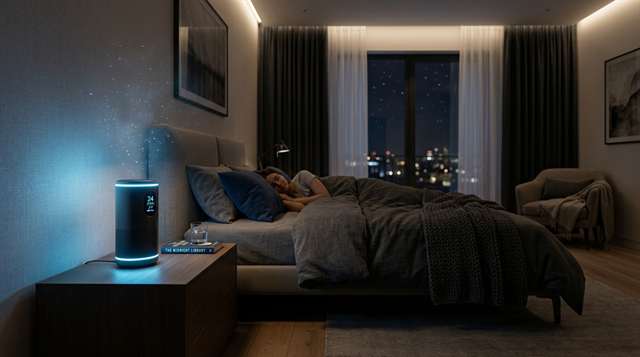
We spend one-third of our lives inside our bedrooms. When doors and windows are tightly sealed to isolate outside noise or maintain climate control, a gradual and hazardous accumulation of indoor pollutants begins.
The Impact on Deep Cellular Restoration
Studies from the Harvard School of Public Health show that inhaling elevated levels of carbon dioxide (CO2) and fine particulate matter under 2.5 microns (PM2.5) stimulates the sympathetic nervous system throughout the night. The body stays in a persistent micro-alert state, cutting delta and REM sleep cycles drastically.
Healthy Homes Lab Finding:
In an airtight bedroom with two sleeping adults and closed doors, CO2 surges from 450 ppm to over 2,200 ppm within four hours. Simultaneously, PM2.5 particles penetrate alveolar barriers, entering the bloodstream and triggering systemic inflammation.
The Solution: Continuous Medical-Grade HEPA H13 & ERV Automation
Randomly opening windows is counterproductive in metropolitan areas due to vehicle exhaust and seasonal allergens. Modern healthy home automation relies on dual-action mitigation: continuous closed-loop HEPA H13 filtration and smart balanced ERV/HRV fresh air ventilation.

- Continuous NDIR Dual-Beam CO2 monitoring (< 800 ppm target)
- Laser PM0.1 / PM2.5 particulate filtration with HEPA H13
- SaniGuardian Sub-slab / Attic Moisture Sockets (HR < 50%)
- Early Warning Water Leak Detection Sensor Array